Monday, June 27, 2016

Let's Talk About Faith Part 4: Saved

1,506 words
12 minute read

Previously on Let's Talk About Faith:  
Introduction / Pre-Church / Confirmation / Saved / Jump / Healing / Mission / Prayer / TheOnly / Work / Leadership / Bible Study / Mental Health I / Mental Health II / Mental Health III / Conclusion


Three years after my confirmation, I finally stepped foot in a church again.  It wasn’t something I had ever planned to do.  But after I graduated high school, I found myself struggling.  Less than two years previously, my sister had experienced a medical emergency.  This affected her, most of all, but our family was impacted as well.  By the time the second anniversary was approaching, I had found I was not coping.

While my sister went to work at her first job, I walked around the house numb with shock.  It seemed that every time my sister left for work, some part of my mind equated her absence with the many hours waiting to hear if she survived surgery.

[Image is: a photo of me taken that December.  I am dressed in a black striped tee shirt with a gray dress shirt over top.]


Finally, in early December, I had enough.  I lay down on the floor of my bedroom with the light off one afternoon and wrote out what I was feeling.  How I was struggling.  As an afterthought, I put Liam’s name at the top.

Liam had been a classmate in high school.  (I graduated as part of a class of over 600 people, so his was a face I recognized, but not much beyond that.)  We’d had a couple of classes together.  At the senior party the night we graduated, he was one of a few who was not uncomfortable around my wheelchair.  He danced with me on and off the entire night.  As he was one of the popular guys in school, his dancing with me made others more willing to approach me, too.

As fate would have it, Tara, Liam and I all ended up not only at the same community college, but in the same psychology class.  Liam sat beside me, and Tara at the table behind us.  He was quiet and respectful but funny, and we often worked as a trio on assignments that merited teamwork.

Liam was a nice guy, and the truth was, I needed to talk to someone about what I was feeling who was outside my family.  Our former pastor at Lakeview, Pastor Sarah, had shown up when things were very uncertain.  Even my beloved former pastor was associated with this time of difficulty.  She was at the hospital with us.  She was checking in and calling faithfully.  So, for a while, seeing her sparked anxiety, as I associated her with not knowing if my sister was going to survive.

At that point in my life, two years later, it seemed that everyone around me was impacted by what had happened just as deeply (or more) than I was.  Tara was the person I could talk to about anything, but our experiences in this instance could not have been more different, so we struggled to communicate.  I needed to share about it with someone for whom the experience was not a raw and open wound.  Someone who would not shut down, fall apart, or be re-traumatized because I needed to talk about it.

I gave Liam this note one day in psych class.  It was the following week before he addressed it, and not in the way I had ever thought he would.

“I read your letter,” he said, “and I was wondering if you both wanted to come to church with me?”

Tara and I exchanged looks.  I had told her about the letter, but this was not how we imagined he might respond.

“What church do you go to?” Tara asked.

“It’s called The Edge.”

We exchanged glances again, dubious.  What kind of name was The Edge, anyway?

He told us where it was and that his sisters would be happy to pick us up for Wednesday night youth group, if we wanted to go.

After some back and forth over the next couple days, Tara and I decided to accept.  We were both struggling.  We both needed something, and Liam heard that.  He did something about it.  Even though it wasn’t what we expected him to do, it couldn’t make things worse, could it?

We decided we’d give it a try.

UNEXPECTED FAITH:

The Edge church was big and welcoming.  In fact, I wrote at the time that “When we walked in, we were immediately greeted by the youth pastors, as well as tons of other people, and they were all super nice and friendly.”

This feeling of being embraced so warmly by peers was not something I was used to.  The sight of my crutches or my wheelchair usually made others standoffish.  But my chair didn’t bother these people.

The service itself was...well...it was weird.

At least, for someone whose only previous experience with faith was a Methodist church.  We could not have gone farther in the opposite direction if we tried.  There were no hymnals.  Song lyrics to modern praise and worship songs were projected on a screen at the front of the sanctuary.  (I was so far removed from religion that I called this “the main room” and knew only that Liam was “at the front of the main room, singing and playing guitar, not that he was part of the worship team.)  There wasn’t a choir.  We did not sit or stand respectfully.  Instead, everyone was invited to jump and dance while they sang.

And the praying…  I had grown up praying mostly silently, or in a call-and-response fashion during the services at Lakeview, with each word prescribed so I always knew just what to say.  At The Edge, kids prayed into a microphone out loud, the way they might talk to their friends.  They cried and yelled and hit the ground with their hands.

After everything finished, I spoke again with the youth pastors, who were so interested, warm and kind.  And still later, Liam asked if Tara and I wanted to go out to eat pizza with him.  It was after 10 PM, but we took him up on his offer.  We enjoyed each other’s company.  Liam asked if we understood the praying that happened and encouraged us to ask questions if we had them.

LOST FAITH:

A few days later, Liam invited me to the Sunday morning service and the children’s Christmas concert that evening.  It was after this event, parked in the driveway outside my parents’ house, that I brought up the letter again.

“I’m sorry if that took you off-guard,” I said, “I just needed to talk.  I hope it was okay.”

“Yeah.  It’s okay,” he assured me softly.

I’d made things sufficiently awkward, so I started getting out of the car.

He stopped me short: “We can talk about this more, if you want,” he offered.

“I don’t know what to say…” I began.  “I feel like I lost my faith in God...and I think that’s not something that should happen.  God blessed our family so much...Tara’s still alive…  I don’t feel anything when I’m praying or in church…”

Liam responded, “Well, I feel something.  I feel something right now.”  Then he asked, “Can I pray for you?”

Startled, I agreed, though in my current state, I couldn’t imagine what a prayer was going to do to change the trauma that was affecting me on a daily basis.

So, Liam prayed for a long time.  My emotional numbness persisted.  Finally, the prayer was finished, and Liam opened his eyes and looked at me:

“Do you feel different?” he asked.

“No,” I admitted.

But that didn’t deter Liam.  He encouraged me to read the Bible and keep praying - and that it was possible that I would feel different that night or the next morning.  “God wants you at your weakest point.”

“Well, that’s definitely me…” I confirmed sadly.

“See?” he said, with a gentle smile.  “You’re perfect.”

SAVED BY FAITH:

The amount of times someone had referred to me, a girl with CP, as perfect were zero until that moment.  Needless to say, the words of affirmation assured that I would be back.  For the next two months, I attended The Edge church at least twice a week.

In mid-February, there was an event at church.  At the end of this event, there was an altar call to which I responded - caught up in the energy of the moment and not wanting to be left out.  I made the choice to acknowledge that I was a sinner, accept Jesus as my savior, and live for God.

I walked into my parents house that evening feeling that for the first time in my life, I had a purpose.  Not only that, though.  I had acceptance.  I had a whole new group of friends and we did stuff together; they liked being around me.  They included me on trips and activities.  I never felt left out or like a burden.

I felt euphoric.

And that was the beginning of the next phase of my life.

I had no idea what I was in for.

***

Don't forget to connect on Facebook / Twitter / Instagram


Let's Talk About In The Land of Canaan

1,699 words
13 minute read

I am very curious to hear your thoughts [on this], and I wonder if some self advocates need to share a response to this. 


I received this message with a link to the new documentary, In the Land of Canaan, last night, from a friend.  I had known this was a film being made by a self-proclaimed "special needs dad" after his daughter passed away.

[Image is: a small girl holding the finger of her father.]

First and foremost, I must say that I do extend the deepest condolences to this family in regards to the loss of their precious daughter.  I hesitated to share my thoughts about this documentary because of the rawness of the family's grief.  I can understand how making a film like this could serve as a sort of therapy, some way to work through what happened, to try to make sense of something so utterly senseless.  But there is danger in doing a project like this when your feelings and attitudes for our community have yet to evolve.  While done with the best of intentions, I have found this documentary to be objectifying, exploitative and ableist, and I cannot in good conscience, have watched something like this, that so harms my community, and not speak up about it.

OBJECTIFICATION:

Very early in the documentary, the daughter who has passed away is referred to as "a door" to a land of insights and higher understanding.  Her father speaks about the "requirement of her life," which, admittedly, made me feel deeply uncomfortable.  The idea that a toddler is "required" to die so that her parents, her siblings and her community can gain insight about life is just plain dangerous.

The child's father proceeds to talk about "the messages these children have come to share."  There is nothing inherently wrong with this statement alone, but having watched all 68 minutes of the documentary, and seeing only one (adult) "child" with a disability speak for 30 seconds it became very clear that it was not the children's message that was key.  It was whatever deeper meaning the parents have gleaned from parenting kids with disabilities.  Their own, grown-up realizations are put on children as young as toddlers, making them out to be objects of inspiration, simply for existing.

In fact, one professional who worked with the filmmaker's daughter said she was "happy in the face of pain," that she "let everyone know they could keep pushing through.  That's what [she] did for us."

EXPLOITATION:

We are advised to "get our Kleenex out" before the film officially begins, which for me, suggested strongly that disability would be framed as tragic and sad.  I was unprepared, though, for the level at which so many children were exploited in this film.

Twelve children (including one teen or adult) had their names and diagnoses shared in full, written in block-style, white lettering against a black background.  These were everything from "never officially diagnosed" to "bowel and bladder incontinence".  One little boy's picture, name and diagnosis was shared, even though he himself never made a single appearance in the film.  Let me say that again: twelve people had their medical histories shared without their consent.

No less than 30 times in the course of 68 minutes were these children blatantly exploited.

There are the more minor instances, which include four times when a child is muted while showing aptitude on an instrument, playing with a sibling or engaging a videographer, all while their parents are heard describing them, telling the audience that their child will, for example "come right up to you and say hi," but the child in question is muted, so we cannot hear him.

Three of the kids (age 18 months through 6 years) are shown in the bathtub a combined six times.  School-aged kids are shown in the process of getting dressed.  Three times, a child was shown without pants, and twice, a child with a back deformity was shown without a shirt.  (This same child's bed and chair were shown, solely for the fact that they were modified to accommodate the child's deformity.)

Three times children ages 5 and younger are shown in the midst of having their medical needs seen to.  Twice, while they are hospitalized and obviously in pain and miserable.  And, perhaps, most disturbing of all, the child at the center of this film is shown an astounding eight times while she is dying.  Once, she is pictured in her casket.

If you would not mute a typical child of a similar age, if you would not feature a typical child of a similar age in any of the above circumstances due to respect for their privacy and dignity, do not do it with a disabled child.  They deserve the same privacy, dignity and respect their nondisabled peers do.

In the credits at the end of the film, every single parent is named and thanked individually, as well as every single donor who funded the film.  But not one of the twelve children is thanked.  Their diagnoses were outed, their real names used, their dignity disregarded and not one of them was thanked in the credits.

ABLEISM:

The degree of ableism in this film was stunning. Bolding is mine, for emphasis.

Babies are the most innocent of victims and the parents even moreso.  We care for the baby and do whatever that baby needs but not far from our minds are the parents.  The parents also have to be rescued, too.

This first quote was said by a NICU staff member who was also a mother of a disabled child.  As someone with CP who was once a premature baby in the NICU, the thought that the parents are somehow more in need of more help and more care than the babies trying to survive is just flabbergasting.  Do parents need help and support?  Absolutely!  But the notion that grown adults require more help and support than the tiny babies that are trying to live is just erroneous and dangerous.

I had such a hard time at first.  I knew what would happen, bringing [my daughter] home.  I knew we would end up loving her, because that’s what you do...everybody ended up loving her because she was so nice.

I'm not a mother and I have never known a child whose disability would ultimately lead to their death.  I can't say that I wouldn't also put up walls emotionally to protect myself from the imminent loss.  But I cringe at the thought that this mother found her own daughter lovable not because she was her child but because she was nice.  I hesitate to even think about what the mom's thoughts would have been had they had a crabby child.  Would they find her less worthy of love?  I'm hoping this was just an instance where Mom misspoke due to the emotion of the moment, because the alternative is too unbearable to comprehend.

We’ve been taught to put our spouse first but we can't do that.  We have to put [our child] first because of his medical needs.

Again, I am not a parent, but I don't know a single one who would put their adult spouse before their children (disabled or not).  When you become a parent, that child does come first, and the notion that putting a child first is somehow a hardship at worst or an adjustment, at least, is troubling.

#MAKEAFRIEND:

After the documentary is over, we are urged to #Makeafriend with a person who is disabled, or with a family who has a child with a disability.  The dad who made the film talks to us in a separate video about a mom who has a 20-year-old son with CP who has no friends.  When the dad asked the mom why he didn't have friends she said it was because he had CP.  The dad says it's due to social stigma, and that we, in society, have to get used to people who "look different, sound different, smell different" (smell.  different.)  Then he urged us to Google images of "people with physical deformities," and see what feelings came up.

He urges us to make friends with people with disabilities because we will "gain more than we could possibly give."  There is even a place at the very bottom where people will be able to share pictures and stories of their friendships with disabled people (or families with disabled children.)

Again, as someone with CP myself, this was super offensive and upsetting.  While the intention is good, all a campaign like this succeeds in doing is further othering us, and objectifying us.  Friendship with us is not viewed in an equal, human, healthy light.  He says "beyond all of the deficits, there is a miracle waiting to happen."

My (able-bodied) friend who recommended I watch this film, said tonight, "I have been friends with you for seven months!  Where is my miracle????"

It sounds funny, but it's also true.  I am not a magical being.  I am not here to inspire her or any other able-bodied person to smile more or overcome challenges.  Ask any of my friends, and they'll tell you: I'm probably the one more likely to ask how they are doing, talk their ear off about what book I'm reading or what I am writing about and then beg them to watch Grey's Anatomy with me.  No miracles, just a friend pretty obsessed with media.

The goal should not be to speak for kids like I once was, but to teach us to communicate whatever we have to say in a way that works for us.

I am not your miracle.  These kids in this film are not your magical "doors" to another land.  They are just kids, living the lives they have been given.  They don't have value because you realized something while parenting them.

They are people.

I'm a person.

We deserve to speak for ourselves, and to have our voices heard.  We deserve dignity and respect and privacy.  We have value because we are human beings.

That is, and should always be, the message.

***

Don't forget to connect on Facebook / Twitter / Instagram


Monday, June 20, 2016

Let's Talk About Faith Part 3: Confirmation

1,218 words
9 minute read

Previously on Let's Talk About Faith:  
Introduction / Pre-Church / Confirmation / Saved / Jump / Healing / Mission / Prayer / TheOnly / Work / Leadership / Bible Study / Mental Health I / Mental Health II / Mental Health III / Conclusion


My family moved when I was nine years old, and with that move, my parents also found a church to attend.  We went briefly, at the beginning of fourth grade.  The people were nice, but there were not many kids our age.  I didn’t like getting up early, and I didn’t like wearing dresses.  The only thing I liked were the doughnuts that were served afterward - and even those did not compare to the ones Dad sometimes brought home as a special treat.  My sister, 6-year-old brother, and I sang in the choir.  I loved music, but did not know how to read it.  I was more concerned about missing Doogie Howser, M.D. (which aired the same night as choir rehearsed.)

Five years later, my sister and I returned to Lakeview United Methodist Church.  My sister shared in a private journal entry that it had been so long since we had attended, we did not remember the name of the church, but that, upon walking in again, “it felt homey.”

While I didn’t keep such a detailed recollection of my teenage years, I do remember coming to confirmation class.  The church had had a shift in leadership since we had last been there and now, was headed by a lovely woman I’ll call Pastor Sarah.

FAITH IN ACTION:

Confirmation class was like nothing I had ever experienced before.  I had no sense of how to find scripture in the Bible, so Pastor Sarah showed everyone.  No judgment.  We were asked to memorize all the books of the Bible, in order.  (Thanks to Wee Sing Bible Songs, Tara and I had that down the same night it was assigned.)  We studied the female attributes of God.  We made masks covered in symbols that we felt represented us.  We even went to a service at a synagogue one evening.

We did a lot of serving others, from teaching Sunday school to the younger kids, to working in soup kitchens.  Pastor Sarah even asked Tara and me to sing for one of the Sunday services, perhaps having heard us sing many a confirmation night.  We performed God Without and Within.  I did not spontaneously combust.  I was never left out of anything during the more service-oriented tasks.  I was always expected to help, even though I was often tentative about taking initiative, unsure of how to make unfamiliar situations work for me.  I was expected to take a turn reading scripture in front of the congregation certain Sundays, just as everyone else in class did.

Prior to a camping trip with our small confirmation class (only four others, in addition to Tara and me) Pastor Sarah informed me that she was required to bring on a seemingly random woman.  “Why?” I asked.

“So you can come with us.”

Whatever the policy was that indicated leadership must bring another person, specifically because I was there, made me bristle.  I knew it was because of my CP and I didn’t like it.  A couple of dads were already coming, and Pastor Sarah.  To my 15-year-old mind, that was more than enough adults.

But Pastor Sarah never wavered.  I was going with them.  Of course, I was.  If that meant a random lady had to come along, then so be it.

On the trip, one of two boys along volunteered to piggyback me across long portages, while everyone else carried canoes, tents and packs.  We had gone to second grade together, and his help was always matter-of-fact. He never made me feel like a burden.  At the end of the week, when we were told to find something in nature for the person whose name we drew early on to do nice things for, I was shocked to find out that he did not have mine.  I had been sure the whole trip that he had drawn my name, and that was why he was being so nice about helping me and not making a big deal out of it.  But no.  It was never like that.

All of us confirmation kids were expected to lead for a day.  That meant me, too.  Of course, me, too.  The only difference was that Tara and I were each paired with one of the two able-bodied girls, to co-lead.  This was Pastor Sarah’s doing, I’m positive, and I appreciated her for thinking of even these details, so that our co-leaders might take on the more physical aspects of leading, while Tara and I took on the other equally daunting aspects of leading for a day.

[Image is: Me at 15, sitting on a picnic bench, on the camping trip I took with my confirmation class.]


LACK OF FAITH IN A PERFECT GOD:

I remember, in the early days of confirmation class, all I felt was insecurity.  Though no one spoke about me being different, I knew I was.  By now, my childish dream of being able to someday walk without crutches was long gone, as I had begun using my wheelchair at school the previous year, to save my stamina.

Perhaps, it was this shift or my ever-present low self esteem, but I was convinced that everything I did was wrong.  If anyone at church knew I wrote prayers to God in a journal sometimes, I felt sure I would be ridiculed, so I stayed very quiet, rarely speaking.

In one of these early meetings, Pastor Sarah mentioned something about God being a “perfect God.”  I mulled over this during the rest of the lesson and when class was dismissed for the night, I remained behind, voicing my confusion to Pastor Sarah:

“How can God be perfect?” I asked.  “Nobody’s perfect.”

“God is perfect.”

Somewhere deep inside me, I felt my real question burning to be asked:

How could a perfect God have made somebody like me?

Quiet and perceptive, Pastor Sarah spoke again.  “You know,” she said thoughtfully.  “There are some people who don’t feel at home in their bodies.”

I looked at her.

“There are girls who feel in their hearts they were supposed to be born boys and vice versa.  Boys who feel in their hearts that they are girls.”

I thought I had Pastor Sarah caught.

“See?”  I said.  “Those kids aren’t happy.  How could a perfect God make those kids if they’re not happy how they’re born?  How could a perfect God do that to them?”

Pastor Sarah looked at me thoughtfully and then spoke again.  “I don’t know,” she admitted.  “But I know God made them.”

FINDING FAITH IN GOD’S WORD:

Months later, and completely by chance, I was flipping through the Bible the previous pastor had given to me when I was nine.  Words that looked like poetry and were, therefore, a bit easier to read than the dense blocks of text caught my eye, from Psalms 139:

You created every part of me; you put me together in my mother’s womb...when I was growing there in secret, you knew that I was there--you saw me before I was born.  The days allotted to me had all been recorded in your book before any of them ever began…

With these words as a kind of confirmation of the ones Pastor Sarah spoke, I began, slowly, to accept myself.

***

Don't forget to connect on Facebook / Twitter / Instagram


Monday, June 13, 2016

Let's Talk About Faith: Part 2: Pre-Church

944 words
7 minute read

Previously on Let's Talk About Faith:  
Introduction / Pre-Church / Confirmation / Saved / Jump / Healing / Mission / Prayer / TheOnly / Work / Leadership / Bible Study / Mental Health I / Mental Health II / Mental Health III / Conclusion


For most of my childhood, I did not go to church.  But the Bible and prayer were never far from my life.  At age five, my sister and I used to pray The Lord’s Prayer each night before bed with our great-grandma.  A couple of years later, Dad started a tradition where he read to me and my siblings from a children’s Bible each night.  We loved the story of creation, in particular, as the Bible we had was illustrated compellingly.

[Image is: On a boat for a fishing trip around 1986.  My sis is in a yellow life jacket, and I’m in an orange life jacket, around age five, before church was a part of our lives.]

FAITH ON CASSETTE:

Around the time this picture was taken, my sister and I were given a cassette tape as a gift, called Wee Sing Bible Songs.  We loved it.  Over an hour of children’s Bible songs!  We learned the words to all of them - which meant we also learned the names of all of Jesus’ disciples and all the books of the Old and New Testament in order (they remain firmly entrenched in my brain to this day.)

I’m going to be honest and say that, at five years old, the lyrics to songs like Silver and Gold Have I None had no relevance to me whatsoever.  I recognized there was a man who could not walk, and Peter healed him, but I never identified with the “lame man” as he is called in the song.  

As I’ve mentioned previously, I identified as able-bodied growing up.  Years of being told I was "just like everyone else", years of longing to be "just like everyone else," meant I clung to the false assumption that I was.  I was just like them (I just used a walker.)  My body worked just like theirs (even though it obviously didn't.)  I always had one foot very firmly in reality.  I was not in denial.  But being surrounded only by nondisabled people taught me to strive as hard as I could to be nondisabled.  I ignored my disability to cope with the fact that I could not ever leave it behind and be like my sister and brothers.

So, the idea of a disabled man begging on the steps of a temple that he was not allowed to enter as long as he could not walk didn’t strike me as anything particularly awful.  It was a story from a long time ago.  That was it.  Hearing the song 30 years later, though, makes my mouth drop open in shock.  What kind of message do songs like this send little kids who are not in so much denial, who actually accept they are disabled?

FAITH IN CARTOONS:

Right around the time we began going to church, I remember watching this certain Christian cartoon on weekend television.  While I can’t remember what it was called, it seemed to be versions of Bible stories featuring children as main characters.

One sticks out in my mind because in it, Jesus Healed the Palsied Child.

I remember watching intently.  Being around eight years old by now, I recognized the word from my disability and wanted to see what Jesus was going to do to heal this little cartoon boy.

There was apparently nothing to it!  Jesus took the boy’s hands and told him to stand up and walk, and he did.  The narrative voice explained “Jesus loved the boy so much that He healed him.”

And I got the message, loud and clear: “Jesus loves me when he heals me.”

FAITH AND REPRESENTATION:

I’m glad that in all of our family Bible reading times, Dad generally avoided the stories of Jesus healing people.  In the text (in the children’s Bible on the audio cassette)  people with disabilities are called “lame.”  In some versions of the Bible, the C-word is still used.  In fact, in some sermons, this derogatory term for disabled people (when used by the nondisabled) is still used 30 times on a Sunday morning, and it is viewed as acceptable.

Words like “lame” were explained to me in a matter-of-fact way by my dad while he read us Bible stories as kids: “Lame is what they used to call people who couldn’t walk.”  I accepted that explanation and moved on.

The reality I see today is that in the Bible, we are not respected.

We are nameless.

Look in any Bible.  We are “a lame beggar,” nothing more.  And today, the notion that there was a man outside the temple where Jesus and his disciples went regularly, maybe for as long as three years, is beyond dismissive.

Today, we are told much the same thing: “You know, we’re only helping you out of the goodness of your heart.  We don’t have to.”

We are often on the outside of churches, because religious buildings are not required to be ADA-compliant.  So, people pass by us on their way into church.  They pray for us.  Tell us to be grateful to those who take time to help us.

But we cannot actually come inside.

It’s easy to say I didn’t know that the Bible wasn’t exactly disability-friendly.  The truth is though, that deep down, it did register.  And I didn’t like it.  People like me were begging for money, and only shown love when we were being healed?

I think, deep down, I felt that rejection.  So, it felt better to imagine myself nothing like that “lame beggar”, nothing like that “palsied child.”

It felt better to imagine myself as someone easy to love.

***

Don't forget to connect on Facebook / Twitter / Instagram


Monday, June 6, 2016

Let's Talk About Faith Part 1: Introduction

822 words
6 minute read

Previously on Let's Talk About Faith:  Introduction / Pre-Church / Confirmation / Saved / Jump / Healing / Mission / Prayer / TheOnly / Work / Leadership / Bible Study / Mental Health I / Mental Health II / Mental Health III / Conclusion

Talking about faith is always tricky.  The risk of offending believers is high, even if we, ourselves have once been on the inside.  Inside the church walls.  Close to the priests and pastors.  To God’s people.  I think, though, it’s important to take the risk.  To talk about the way faith shaped me as a woman with CP.  Ways it helped, and ways it hurt.

WHY DO YOU WANT TO TALK ABOUT FAITH?

I am not a Biblical scholar, and I don’t speak for everyone out there with a disability.  (As I like to say, my blog is called Tonia Says for a reason.)  I am a layman, with a commoner’s understanding of what the Bible says.  My desire is not to offend people, nor is it to debate the validity of my own experience.  I’m sharing now because I believe there are more disabled people out there than just me who have known experiences like this.  I also think it’s important to talk about because if pastors and other church leadership finds these posts, perhaps they will find that there is something to be learned.  Disabled people are one of the biggest minorities in the world, and Christianity is the primary religion in America.  The majority of my experience with faith has been that the community does not embrace me, or that I do not fit.

I was late coming to faith.  First accepting God as my savior at fifteen, without much understanding of what I was doing, only not wanting to be left out.  At eighteen, I was saved again.  And again, it was largely the desire for acceptance that drove me, not a spiritual desire of any kind.  I went to church until the age of 26, when I left.  I didn’t know my last time was my last time, until I could not bring myself to go back.  The rejection was just too much.

THE WRONG FAITH:

I wrote about my sister’s and my early birth back in 2009.  I also shared the details about what happened, according to my grandma, when a priest was called because we were so premature at nine weeks early, that our survival was unlikely:

10398388_106039022180_1572100_n (1).jpg
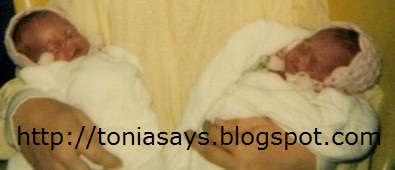
[Image is: My sis and me - I’m not sure who is who - being held by our mom.  We are one month old.]

No one expected us to live beyond a few hours, and a Catholic priest at a local church was called to baptize "Baby A" and "Baby B".

The priest came, by accounts, annoyed at the early Sunday morning call. Apparently, he looked at my 16-year-old mom, exhausted from twelve hours of labor with two premature daughters and asked her, "Are you Catholic?"

When my mom said no, he refused to baptize us, and left the hospital.

Admittedly, I do not know all the ins and outs of the Catholic faith.  I’m not Catholic.  Perhaps it was wrong for my grandma and mom to reach out to this priest in particular, as neither were Catholic in the first place, but we were so tiny, and not expected to make it.  I imagine my mom and grandma were quite desperate, especially because we seemed at death’s door.

The fact that this particular priest had no apparent compassion for my family’s situation - on the brink of losing two babies - has always rubbed me wrong.  I feel there are so many other ways he could have showed love to my family and to us.  If baptism was not a possibility by him, he might have gently referred my family somewhere else, or offered to sit with them while they waited for someone who could legitimately baptize us.

We were baptized, as the story goes:

An Episcopal priest was called instead, and he baptized us. We were both so tiny at two pounds apiece, that he could hold my sister and me in the palm of his hand.

FAITH IN HINDSIGHT:
Today, my sister is the person who knows me the most deeply.  While planning for these posts, she observed:  “As your first experience with religion was essentially rejection, is it any wonder that you were willing to go to any lengths, endure any humiliation, to find acceptance?”

She isn’t wrong.

I do wonder how much of the experience, at two hours old, coupled with a more visible disability that caught people’s attention, informed my eventual experiences with faith.  

Over the next few months, you will see just what she means.  Just how desperate I was to find acceptance, to find a place to belong.  Every Monday, from now through early September, I will be sharing a new post in this summer blog series.  I will touch on everything from pre-church experiences to experiences in leadership as an adult.  Names and places will be changed.

Feel free to read along, and if you like, share your own story.


***

Don't forget to connect on Facebook / Twitter / Instagram


Monday, May 30, 2016

Let's Talk About Stereotypical Portrayals of Disability on TV

2,089 words
16 minute read

Hey T, Have you seen this season of Bones? It has been interesting and I wondered your thoughts about it.

I received this message from a friend recently along with a corresponding article detailing secondary character, Jack Hodgins’ paralysis in the show’s winter finale.  I was put off by many things in the article alone, and even though I was fairly sure about the kind of portrayal I would see, I checked out five episodes (11x12-11x16) anyway.

wheelchair-567812_960_720.jpg
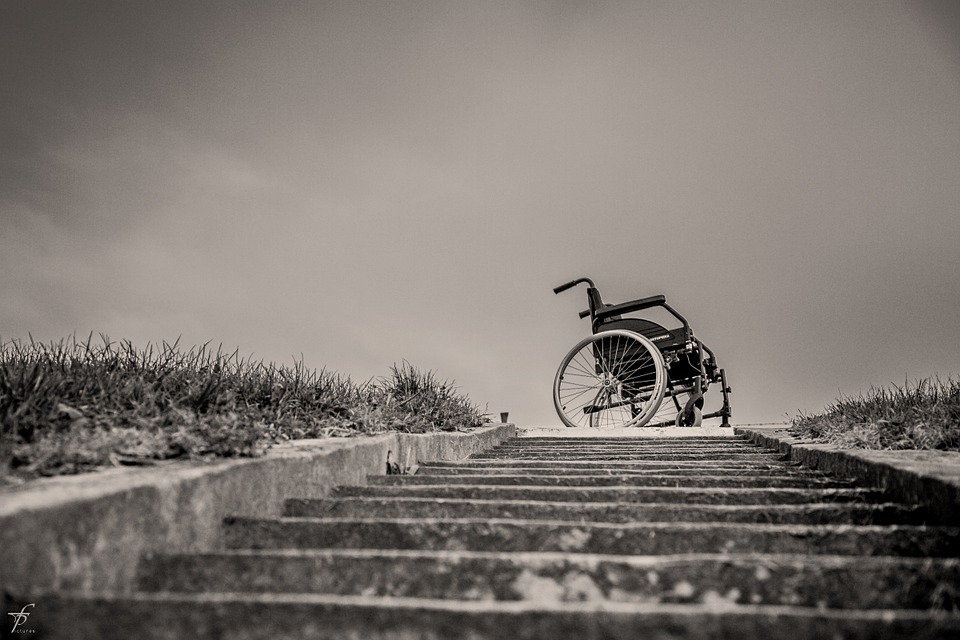
[Image is: a wheelchair at the top of steep steps outdoors.]

PORTRAYAL ISSUES:

Disability as a Plot-Device:  Hodgins’ paralysis (as the majority of characters’ disabilities in media) exists exclusively as a ‘new challenge’ both for the character, and the actor who plays him.  In this sense, the lives of actual disabled people are viewed as an exercise, not as a reality.  Bones is apparently going to end after a 12-episode season 12.  Season 11 is already half done.  Chances of any depth or reality to this aspect is slim in my opinion.  This is dangerous and problematic because it objectifies disabled people.  Our lives as disabled people are viewed one-dimensionally, as a sad nightmare from which the character cannot awake, and an unimaginable challenge to grieve and cope with.  

Representation:  While absolutely not specific to this show, the issue of casting an able-bodied actor in the role of newly-paralyzed character, Hodgins is an issue.   We not only must contend with the inherent stereotypes coming from the able-bodied writers and directors, but the those of the actor (who uses words like “chair-bound” to describe his character.)

In order to get into character, actor T.J. Thyne, stays in the character’s wheelchair all the time on set, even when it is inconvenient for him (as stated in the linked article above.)  This is viewed as admirable and as proof of just how deep Thyne’s commitment to this new storyline is.  When I read that he was looking to portray disability accurately, I hoped he may discuss speaking with actual spinal cord injury survivors, but no, he chooses to remain in the chair at all times.  

I saw an example of this during a commercial during the last episode I watched via OnDemand.  The actors were a part of some good deed, and as it was on set, Thyne was in the wheelchair, though he clearly was not in-character.  I can’t quite specify just how seeing this resonated as “wrong” to me, but it did.  Perhaps because it takes my (and many people’s) legitimate identities as disabled people and minimizes them to a prolonged instance of disability simulation, which does nothing but promote pity and stereotypes.

The biggest issue I find with able-bodied actors portraying disabled characters is that it always comes off feeling like a mockery to me.  The reason for this is, there are specific things we do as disabled people (and more specifically, things that people who are paralyzed) do, that able-bodied actors do not.  

If you want a great example, watch the way Thyne pushes his wheelchair as Hodgins.  Now, watch Ali Stroker push her chair.  Thyne pushes the chair the way able-bodied people walk.  Using a wheelchair is not the same as walking.  We move differently. I have very rarely seen a person in a wheelchair “pace” for example, but I have seen able-bodied actors portraying wheelchair users do this. I very rarely see wheelchair users in motion who stop just to gesture while the speak and then keep going.  More often, we will use our heads to gesture, or park completely before engaging in a conversation that requires our hands.

It also needs to be said: this singular lens through which disability is viewed on television is limiting at best.  Paralysis is not the only physical disability that exists.  Cerebral Palsy, Osteogenesis Imperfecta and Muscular Dystrophy are just three examples of others that exist from birth.  Straight, white men are not the only people who are disabled.  Women are disabled, too.  So are people of color.  So are LGBTQIA+ people.  Many times, these minority identities crossover and a black woman is disabled, for example. But we rarely, if ever, see these representations on television.  I understand that it is the closest able-bodied people can likely come to envisioning themselves disabled, but it does those of us who have grown up disabled few favors.

This narrative, in particular, feeds the erroneous assumption that disability is the product of something tragic and that our lives post-disability are equally tragic.  

Also, in one horrifying moment, Angela confides in a co-worker that she is “trying to think of ways to kill my jerk of a husband.” It is played for laughs.  There seems to be a lack of knowledge on all parties’ parts that caregivers murdering disabled people in their charge is a frightening reality that we in the disabled community must live with.  (As well as living with the knowledge that those responsible are rarely if ever charged with a crime.)

If there were a disabled person in the writer’s room, or a disabled consultant present, “jokes” like these would never slip past us, and we would know just how chilling it is to hear a wife say those words about her newly-disabled husband.

Accessibility as a Non-Issue:  Perhaps accessibility was touched on more in previous episodes but in the five I saw, accessibility was basically a non-issue for Hodgins.  There is one moment where he meets his friends at a local diner and someone trips over his chair.  They briefly talk about going somewhere else but Hodgins insists that they keep coming to the same place because it’s tradition.

He goes back to work seamlessly.  Hodgins seems to be able to reach and access absolutely everything he could ever need without a problem.  He is able to continue doing his job with little to no accommodations, from what I could see.

Most glaring, for me, was seeing Hodgins navigate with no trouble around his own home.  Especially as his injury (and thus, the chair) is new, I imagined I might see a bit of struggle on his part over carpet, around furniture not positioned with a wheelchair in mind, and navigating doorways that are just too narrow.  

This may seem like I am being nit-picky but accessibility as a wheelchair user is not a given, and just as it is maddening to see fictional shows flagrantly disregard the existence of the ADA and insist that characters in wheelchairs are not provided accessible transportation, it’s equally unbelievable to see a newly paralyzed character encounter no difficulties navigating through his workplace, his home or anywhere else.

STEREOTYPES:

Becoming Disabled Makes Character a Jerk:  I have not seen Hodgins prior to his injury.  I’ve only had the word of fellow characters telling me he has changed to let me know he has not always been an absolute jerk.  He’s very dismissive to his co-workers, and specifically to his wife, whom he also works with.  He ignores her or makes mean comments.

Disabled Character Makes Awful Dark Wheelchair Jokes:  This may seem like a small issue but the way we speak about ourselves as wheelchair users is so important.  I have rarely if ever heard someone in a wheelchair balk at a legitimate comment from a co-worker/friend about out-of-line behavior with a retort asking that friend “what they call themselves for putting down someone in a wheelchair?”  

The reality is, we receive so much pity as it is that the idea of asking for more just seems absurd.  But Hodgins does this, drawing weird, dark attention with bad jokes about his legs not working, and accusing people of expecting him to come to them when he is in a wheelchair.  

Disabled Character Wants to Be Healed:  I understand (as best as someone who has been disabled from birth can) that a new injury later in life can be a huge adjustment.  It can take time.  But again, when the only portrayals we see on television are that of disabled people longing for a cure for their disability, it feeds the notion that we all lead miserable lives and none of us are happy.


Able-Bodied Heroes and SuperSpouse:  This show is full of able-bodied heroes!  Pretty much everyone other than Hodgins thinks they know better than him about what he needs or what should be done about this or that personal issue.  These five episodes are full of Hodgins getting put in his place by the able-bodied characters about how wrong he is to be coping as he is.

SuperSpouse is a variation of SuperParent, Angela, Hodgins’ wife is often the focus of storylines that should focus on Hodgins.  She is sad to be treated so badly (legitimate) however, her long-suffering “it’s just the way he talks to me now.” and “this is him on a good day,” just feed the notion that Hodgins is the recipient of so much love and sacrifice on Angela’s behalf.  He should be grateful and he is not.

In a totally strange example that is somehow both of these themes, Hodgins bonds with some rats, and is all about taking them home and not disposing of them now that they no longer have use in their current investigation.  Hodgins is also very excited about a possible surgery that might restore his ability to walk.

Angela talks to Hodgins at the end of the episode (very condescendingly) about how he seems to value the lives of those rats quite a bit.  (Sidenote: I don’t even know what to say to the idea that Hodgins is identifying with rats…)  Angela tells Hodgins that these rats undergo all kinds of tests that kill them because they are super risky, and isn’t he more valuable than the rats.  Hodgins agrees that he is and that he will be on the lookout for a different surgery which poses less risk to him.  Then they take the rats home.  Disgusting.

Disabled People as Props and Gawking Without Talking:  These two inspiration porn themes were huge in the episodes I watched.  Hodgins is often talked about by Angela outside of his presence.  One instance includes Angela discussing with a friend at work that he can still be intimate because everything still works.

While it is definitely common that women (especially those who are friends) discuss such things, adding disability into the mix creates a new layer that able-bodied people often don’t consider.  As disabled people, we are often objectified by the nondisabled public.  They often feel entitled to very personal information about us, including our diagnoses, how we use the bathroom, and how we have sex.  Angela discussing what Hodgins can still do in bed crosses that line, in my opinion.  If Hodgins were present and at ease with the topic of conversation, it would be another matter.  But I am fairly certain that this conversation would not have happened in his earshot.

In another episode, Hodgins is trying to make up for his previously mean behavior by severely overcompensating and buying Angela ridiculously expensive jewelry.  We see she is uncomfortable at the gifts’ cost, but Hodgins insists she have them.

At the end of the same episode, all of the Bones co-workers are out to eat, and they are toasting that Hodgins is out with them again.  At this, Angela elaborates that Hodgins is out with them because she has given the jewelry he gave her to a fellow female co-worker, and in order to “get it back” he has to go out with Angela three more times that month.

Hodgins is not angry at the fact that his wife gave her jewelry (from him!) to another woman.  He is not humiliated that she is treating him like a child by removing what he obviously deems valuable until he does what she wants.  Instead, Hodgins smiles at Angela and holds her hand without saying a word, as if her actions are the most romantic thing he has ever heard.

CLOSING THOUGHTS:

While I used the show Bones for specific examples, I find TV regularly misrepresents disability in these types of ways.  (Past examples include Glee and the remake of Ironside.)

I would love to see that change, especially as I know of so many Deaf and disabled actors who would love to represent characters like themselves in non-stereotypical ways.  As an audience member, I would love to see authentic representation, as well.

It’s my hope that, over time, this continues to change.


***

Don't forget to connect on Facebook / Twitter / Instagram


Monday, May 23, 2016

Let's Talk About The Time I Dropped My Mom's Mother's Day Flowers on The Ground

1,195 words
9 minute read

THE PLAN:  


It was the day before Mother's Day, and because we are awesome daughters who always plan ahead (not!) my sis suggested before she went to work that I might want to go to the greenhouse and pick up some flowers.  This had been our plan.  Who doesn't love flowers?  (Our mom LOVES them.)

"What kind should I get?"

"Whatever you think are pretty, she'll think are pretty."

Okay, then.

THE BEST ONES:

About 9:30 that morning I headed out, hoping the greenhouse was open.

I got there in a few minutes' time, with only a few missteps (misrolls? - like "the giant sign SAYS the greenhouse is open but how do I get in???")

It was pretty busy.  No doubt everyone else had the same idea.  (We love our moms, but we suck at pre-planning.)  So I perused the flowers, taking off my sunglasses to really appreciate all the colors and determine which were the very best.  I spied a pot of I-had-no-idea-what but gosh they were gorgeous.  I went by them, with the intent of checking out if there were others I liked better, but an irrational sense of ownership washed over me.  I thought, What if someone else takes the best ones???  I can't let them take the best ones!

THE LINE: 

So, I tested the weight of the pot, and as it wasn't massive, I set it on my lap and got in line behind a guy with seriously disturbing tattoos.  (His arms were right at my eye level, to be fair, and I'm pretty sure the ink either depicted someone dead or an alien...on each arm.)

It was a long line and the register was down, but it was a nice day, so I just hung out with my flowers, at a standstill when:

"Sweetheart, can I pray for you?"

He came out of nowhere.  Not Tattoo Guy, but older, squatting in front of me.  I recognized this stance from almost a decade in nondenominational charismatic church.  Praying Man was ready to get his prayer on.

I hesitated for a moment, knowing how dangerous it can be to say no.  But I thought of a helpful article I'd read about all the different ways to say no, when you don't feel safe.  I settled for a pleasant, "Ummm...No, thank you!" with a smile.

"Okay!" said Praying Man.  Not sounding angry, but panicked, like maybe I had The Plague.  In any case, he disappeared like a mirage.

The ladies around me in line were shocked.

("Did he just ask to PRAY for you?  UNBELIEVABLE!")

("You've got to be KIDDING ME!)

So I arrived at the register, paid, and then asked if someone could please stow the pot of flowers in the bag on the back of my chair.  They tried.  Then they told me, "I don't think I'd trust this..."  As they had the better angle, I trusted them.

Off came the fanny pack, which went into the bag.  Now, I had enough lap space to carry the flowers home.  It was smooth rolling across the parking lot, until I saw that the curb cut to the sidewalk was on the other side of a giant speed bump.  I could just imagine these beautiful flowers biting the dust, so I waved down a passerby and asked if she wouldn't mind giving me a hand over the bump.  She did.

THE ROLL HOME:

I was on the sidewalk and on the lookout for the massive crack that stopped me cold on the way there.  I spotted it and rolled over super carefully.

Freedom!

I noticed a woman out of the corner of my eye reprimanding her young daughter.  When she saw me, her tone changed.  For me it was all pity voice, all the time.

"Do you need help?" she asked, like she'd ask a toddler if they got an owie.

"No, thanks, I got it!" I answered cheerfully.

I was almost to my final landmark, which meant home was nearly in sight when I was jarred forward and had to grab the wheels to make sure I didn't tip over.

Massive sidewalk crack.

Mom's beautiful flowers upside down on the ground.

A new lady came running to help.  She picked up the pot and handed it to me.  Only one yellow flower and a little dirt remained behind but the flowers in the pot were flatter now.

"Do you want me to carry these for you a little way?  I'm going into the store up here."

"Sure, that would be great, thank you so much!"

Just then, a car pulled up.  The voice inside said, "I can drive these over for her."

New Lady eyed me, to see if I was on board.  Asked the woman in the car questions.  She was suspicious and I appreciated it.  I appreciated that she didn't just pass off my flowers to this random person and go on her way.

I agreed, though, to let the woman in the car drive the flowers home for me.  I'd already dropped them once.  It was a miracle they survived.  I knew I'd be silly to pass up help at this point.

"Yeah, that's fine," I told New Lady and she passed the flowers off.  "Thank you so much," I added, to the woman in the car.

But the woman in the car wasn't talking to me.  She was talking to New Lady.  "Yeah, I offered to carry them for her, but she said no.  I KNEW she would drop them!"

Oh crap.  It's Pity Voice.  I just agreed to give Mom's flowers a ride home with PITY VOICE.

New Lady, responded, "Yeah, I just picked them up off the ground..."

"Ohhh.  Thank you for picking them up for her.  That was SO NICE of you!"

So, we were off.  She drove ahead and got out of the car, meeting me at the back door.

Every single thing she said to me was in that tone of voice:

"You're getting your exercise today!"

"Do you need help up this hill?  I don't want to help you if you want to do it yourself..."

"My daughter likes to help out the kids who are in wheelchairs at school, so if she touches your wheelchair, don't worry about it..."

She brought the flowers all the way in, set them on the table and advised me that a little water would perk them right up.

"Thank you so much," I said, and hated myself a little.

When she said "You're welcome," it sounded like she felt like I had the worst life ever, AND that I was some infant who didn't know how to carry flowers home.

I don't think I'd ever been so glad to close and lock my door.

THE MOM SEAL OF APPROVAL:

Sunday morning, I got a text:

"Thanks so much for the flowers and candy.  So nice!"

I apologized for the state of the flowers, but Mom insisted:

"They are gorgeous and will fill back in in no time!"

Well...I can't really argue with that.

[Image is: Mom's pansies, only a little worse for wear.]


***

Don't forget to connect on Facebook / Twitter / Instagram